Architectural Metal Mesh Compliance Guide: Certifications & Standards
Architectural Metal Mesh Compliance Guide: Certifications, Standards & Regional Requirements
Architectural metal mesh does not carry one global approval. A CE-CPR certificate issued for a mesh curtain model does not automatically cover an aluminium expanded ceiling panel. A woven wire cloth specification does not answer a fire-safety question on a balustrade. A stainless steel material certificate does not certify an installed facade system. Compliance in this product category is assembled project by project, document by document.
This guide is written for specifiers, facade contractors, importers and distributors working through the research and evaluation stage of a metal mesh package. It sets out the four layers of a metal mesh compliance file, shows how the same request changes between the EU, North America and other markets, and maps documentation needs across facades, ceiling systems, balustrade panels and decorative partitions. Product references are drawn from the range manufactured by Shenzhou City Jumao Metal Products Co., Ltd (Jumao), an Anping-based manufacturer and exporter of custom architectural metal decorative materials serving the Middle East, Southeast Asia, the European Union, North America, Australia and Africa.
The Compliance Question Buyers Ask — and Why It Misfires
Most metal mesh compliance requests start with one sentence: “Is your architectural metal mesh certified?” That sentence cannot be answered accurately with a yes or a no, because the word “certified” covers at least four different things in this category — a material certificate, a product or system conformity certificate, a test report, and an approval issued by a local authority for a specific building. Each is produced by a different party, and each answers a different question.
The second difficulty is scope transfer. A certificate is written against a defined product description, model designation, market and standard. When a project changes from a woven stainless steel curtain to an aluminium perforated panel, or from a 304 interior partition mesh to a 316 exterior cable mesh, the original document no longer answers the new question. Buyers who forward a certificate without checking the model line often discover the gap during submittal review rather than during the quotation stage.
The third difficulty is that mesh is one component inside a larger assembly. Architectural mesh installed on a commercial building facade, interior ceiling or decorative partition works together with subframes, facade support brackets, aluminium profiles, stainless steel fasteners, suspension systems and curtain wall fixing accessories. Material conformity sits with the mesh supplier; system-level performance, wind load, fixing design and installation compliance sit with the facade engineer and contractor. Treating the mesh certificate as a system approval is a common and avoidable error.
Why Compliance Documentation Has Become a Procurement Gate
The volume of documentation requests has grown with the market. The global architectural metal mesh panel market was valued at USD 1.2 billion in 2024 and is projected to reach USD 2.5 billion by 2034 (Reports and Data). The broader metal mesh facade segment is estimated to reach USD 10.59 billion by 2034, growing at a CAGR of 6.2% (Growth Market Reports). The two figures measure different scopes — panels versus complete facade applications — which is itself a useful reminder that compliance scope should always be read together with the number attached to it.
Supply is concentrated. China dominates global wire mesh supply with an estimated 65% market share in 2024 (IBISWorld / Industry Reports), and China’s export value of steel wire products, including wire mesh, reached USD 14.5 billion in 2024 (Global Growth Insights). The Anping wire mesh cluster in Hebei alone hosts more than 3,600 specialised factories as of late 2024 (Anping County Government / Industry Statistics). Asia-Pacific is the fastest-growing region for facade systems, including metal mesh, driven by urbanisation and infrastructure investment (Market Research Future).
More suppliers, more product variants and faster project cycles produce more documentation variance. On the technical side, woven wire mesh remains the dominant product segment, accounting for approximately 43.2% of total metal mesh revenues in 2025 (Dataintelo), while expanded, perforated, cable and ring mesh fill the rest of the specification space — each with a different documentation logic. On the performance side, published industry material indicates that architectural sun shading metal mesh can reduce solar heat gain by up to 50% depending on mesh aperture and material (Cambridge Architectural). Because that range depends on the individual specification, the parameter sheet becomes part of the compliance file rather than a sales attachment.
On the supply side, the market includes long-established European and North American producers. GKD Gebr. Kufferath AG holds a global market share of approximately 11.4% in the technical woven wire mesh sector as of 2024 (Global Growth Insights), and published competitor lists for the architectural mesh market name GKD (Germany), Haver & Boecker (Germany), Banker Wire (USA) and Cambridge Architectural (USA) (Growth Market Reports). For buyers, the practical consequence is not a ranking question but a documentation question: comparable mesh products are frequently described with different reference frameworks, and the differences must be reconciled inside the project file.
The Four Layers of an Architectural Metal Mesh Compliance File
Layer 1 — Material: EN 10088 and the 304 / 316 Split
Material conformity is the foundation of every mesh document pack. Stainless steel architectural mesh materials are commonly specified under EN 10088, the European standard for stainless steels (Industry Material Standards). Grade selection follows exposure: standard stainless steel mesh for facades typically uses Grade 316 for exterior corrosive environments and Grade 304 for interior applications (Stainless Steel World).
That split is visible across the Jumao range. Exterior-facing items such as the Stainless Steel Facade Cable Mesh JM-W-014 and the Staircase Safety Metal Mesh JM-C-1082 are produced in stainless steel 316, while interior items such as the Decorative Metal Mesh Partition JM-C-1013 are produced in stainless steel 304. The Metal Mesh Balustrade Panel JM-C-1017 is available in both stainless steel 304 and stainless steel 316, so the grade has to be fixed before the certificate request is sent. Aluminium items — for example the Expanded Metal Facade Cladding JM-E-573 and the Aluminium Perforated Facade Screen JM-P-416, both in aluminium alloy 3003, or the Decorative Metal Ceiling Grid JM-NT-062 in aluminium alloy 1100 — fall outside stainless steel material standards entirely. A specification that names only EN 10088 will therefore leave every aluminium component undocumented.
Layer 2 — Construction Type: Woven, Expanded, Perforated, Cable and Ring Mesh Follow Different References
Metal mesh is not one product family with one standard. Construction type determines which reference framework is relevant:
- — architectural mesh for facades often adheres to ASTM E2016, the standard specification for industrial woven wire cloth (Haver & Boecker). This applies to woven items such as the Stainless Steel Woven Wire Mesh JM-C-1083 and the Architectural Decorative Metal Mesh JM-C-1080.
- — expansion metal mesh in architecture is governed by standards set by the National Association of Architectural Metal Manufacturers (NAAMM) EMMA division (NAAMM). This covers expanded products such as the Expanded Metal Mesh Panel JM-E-529 and the Aluminium Diamond Mesh JM-E-1067.
- — flexible systems such as the Architectural Cable Mesh JM-W-013 and the Metal Ring Mesh Curtain JM-R-4205 are specified through cable diameter, mesh opening, material grade and tension or track fixing rather than through a cloth standard.
- — the Aluminium Perforated Facade Screen JM-P-416, the Perforated Metal Panel JM-P-1987 and the Laser Cut Metal Screen JM-E-526 are typically documented through material grade, sheet thickness, hole diameter or pattern, open area and surface coating rather than through a woven or expanded mesh standard.
Read together with Layer 1, this is where most mismatches appear: a buyer requests “the mesh certificate”, the supplier sends a woven mesh document, and the project actually contains expanded and perforated panels with different parameters.
Layer 3 — Certificate Scope: Read the Model, Market and Validity Line
A conformity certificate is only useful when its scope is read in full. Jumao holds a Certificate of Conformity (EU-CPR) with certificate number CTB160418002S-ZS, issued by Shenzhen CTB Testing Technology Co., Ltd for the EU market. The standard listed on the certificate is EN 13830:2003. The scope is stated as Metal Mesh Curtain, Model JM-MMC, Trade Name JUMAO. The issue date is 2016-04-25 and the expiry date is 2099-12-31.
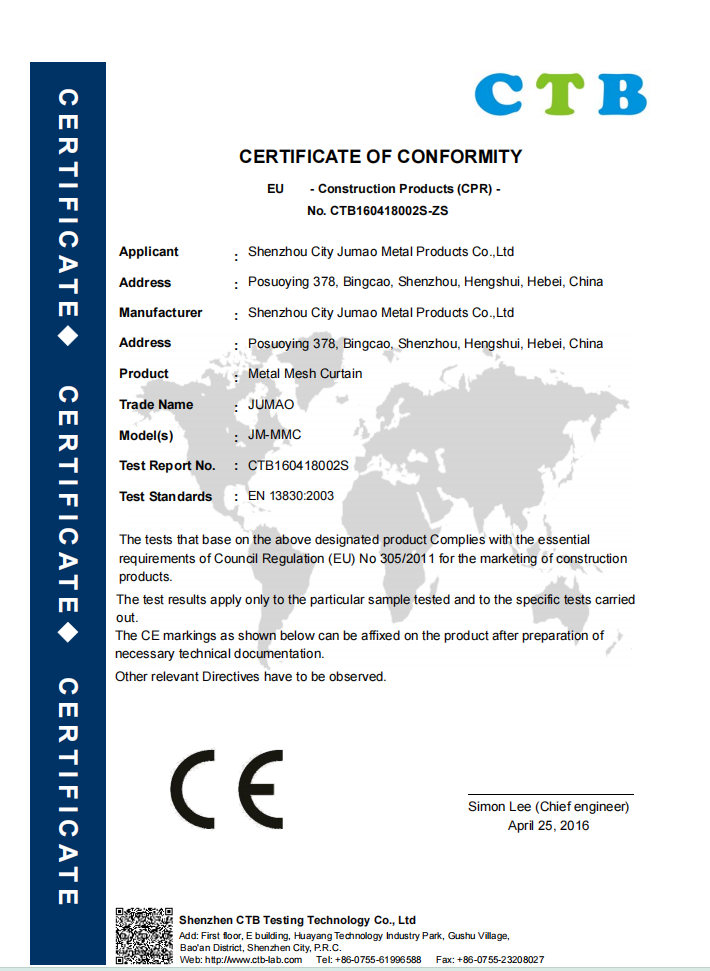
The products associated with this certificate include Architectural Decorative Metal Mesh (JM-C-1080), Ceiling Hanging Mesh Curtain (JM-R-4205) and Hotel Decoration Metal Mesh (JM-A-822). Three review points follow directly from this structure, and they apply to any supplier’s certificate, not only to this one:
- — the model named in the scope must match the item being ordered, or the buyer must accept that the certificate does not cover the deviation.
- — this certificate is issued for the EU market. A project in North America, the Middle East or Southeast Asia is normally reviewed against its own local and project requirements.
- — check the issue date, expiry date and the standard cited, and keep a copy of the PDF in the project file rather than a summary sentence in an email.
Layer 4 — Project Level: Fire, Load, Fixing and Local Approval
The fourth layer belongs to the building, not to the catalogue. Two identical mesh specifications can require different documentation because one is a decorative interior ceiling in a shopping mall and the other is an exterior cladding screen on a transport building. Mesh applications in this category are permanently installed, passive architectural systems requiring no external power and low maintenance, and they interact with facade mounting brackets, suspension hardware, aluminium sub-frames, stainless steel fasteners and curtain wall accessories. Fire safety, structural performance, wind load and local approval are therefore shared responsibilities: the supplier documents material and fabrication, while the system designer documents performance in situ.
Jumao supports this layer with engineering drawing support, installation system recommendations, installation guidance, maintenance advice and remote technical support, and offers third-party inspection such as SGS and TUV on request — a practical route for projects that need an independent verification step rather than a supplier-issued statement.
Standards Comparison: Which Reference Applies to Which Mesh System
The table below compares the reference frameworks most often named in metal mesh specifications and tender documents, and states where each one actually applies.
| Reference | Region | What it addresses | Where it applies in a mesh project |
|---|---|---|---|
| EN 10088 | Europe | Stainless steel grades and material designation | SS304 and SS316 wire, cable and ring mesh materials (for example JM-C-1017, JM-W-014, JM-C-1013) |
| ASTM E2016 | USA / global reference | Standard specification for industrial woven wire cloth | Woven wire mesh facades and screens (for example JM-C-1083, JM-C-1080) |
| NAAMM EMMA | USA | Architectural expanded metal standards set by the NAAMM EMMA division | Expanded metal facade cladding, sunshade and ceiling panels (for example JM-E-573, JM-E-529) |
| EN 13830:2003 | EU (as listed on the certificate) | Standard cited on Jumao’s EU-CPR Certificate of Conformity No. CTB160418002S-ZS | Certificate scope: Metal Mesh Curtain, Model JM-MMC, Trade Name JUMAO |
| Material grade practice: 316 / 304 | Global | Exterior corrosive environments versus interior applications | Grade selection before documentation is requested |
Nothing in this table replaces a project specification. Its purpose is to stop a common error: quoting a woven cloth standard for an expanded metal ceiling, or a material standard for an aluminium perforated facade screen.
Step-by-Step: Assembling the Documentation Pack
The following sequence can be used as a working checklist from first enquiry to pre-shipment inspection.
- Construction: woven, cable or rope, ring or chain, expanded, perforated, laser-cut. Application: facade or cladding, sunshade, ceiling, balustrade or safety panel, decorative partition, landscape. This single step determines the reference framework in most cases.
- Stainless steel 316 for exterior corrosive conditions, 304 for interior work, aluminium alloy 3003 or 1100 where weight and forming matter. Surface finish must be specified at the same time: powder coating or PVDF fluorocarbon coating for expanded and perforated panels, titanium coating in black, bronze or gold for coloured stainless steel mesh such as JM-C-1045, and antique copper for decorative woven mesh such as JM-C-1080.
- Ask for the certificate PDF and compare the product description, model designation, market and validity dates with the item being purchased.
- A usable sheet states material, wire or sheet thickness, mesh or hole opening, open area, panel size, frame or fixing method and surface finish. Open area and aperture matter twice — once for design performance and once for documentation.
- EU projects normally centre on CE-CPR documentation plus material standards; North American projects commonly reference ASTM E2016 for woven cloth and NAAMM EMMA for expanded metal; projects elsewhere are usually governed by the local authority and the project specification.
- Documentation work and sampling run in parallel with commercial terms: MOQ at Jumao is 1 square metre, lead time is 7–60 days depending on order quantity and customisation, and monthly capacity is 5,000–10,000 square metres.
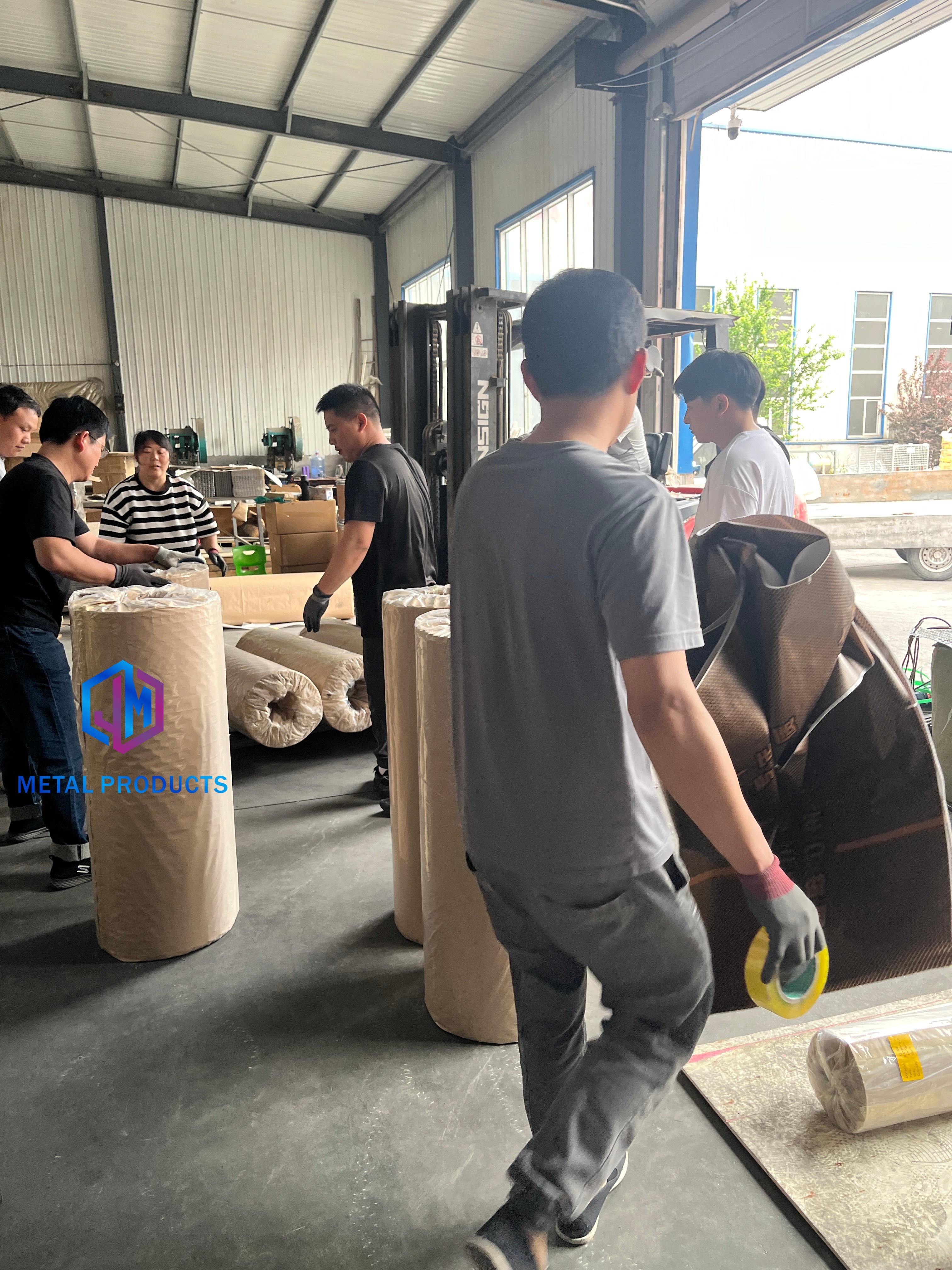
- Ask which quality checks are performed and recorded. Jumao’s process covers raw material inspection, dimensional inspection, welding quality inspection, surface finish inspection, flatness inspection, colour consistency inspection, packaging inspection and 100% pre-shipment quality inspection, with third-party inspection available.
Documentation Matrix by Application
| Application | Typical Jumao mesh options | Documentation priorities |
|---|---|---|
| Facade, cladding and sunshade | Expanded Metal Facade Cladding JM-E-573; Aluminium Perforated Facade Screen JM-P-416; Stainless Steel Facade Cable Mesh JM-W-014; Facade Solar Screen Mesh JM-S-2602; Parking Building Facade Mesh JM-S-2607 | Material grade for exterior exposure, aperture and open area, PVDF or powder coating schedule, tension or frame fixing system, corrosion and structural input from the system designer |
| Ceiling systems | Aluminium Stretch Metal Ceiling Mesh JM-C-1013; Decorative Metal Ceiling Grid JM-NT-062; Metal Ring Mesh Curtain JM-R-4205; Metal Mesh Ceiling Panel JM-E-529 | Panel size and grid opening, suspension method, surface coating, flatness and colour consistency records |
| Balustrade and safety panels | Metal Mesh Balustrade Panel JM-C-1017; Staircase Safety Metal Mesh JM-C-1082; Architectural Cable Mesh JM-W-013 | Material grade, wire or cable diameter, mesh opening, frame installation details, load-related input from the responsible engineer |
| Decorative partitions and interiors | Decorative Metal Mesh Partition JM-C-1013; Architectural Decorative Metal Mesh JM-C-1080; Titanium Coated Stainless Steel Mesh JM-C-1045; Custom Pattern Metal Mesh JM-A-822 | Surface finish and colour, edge and frame treatment, custom pattern confirmation, cleaning and maintenance guidance |
Use Cases: How the Request Changes by Application
Facades, Cladding and Sunshades
Exterior projects carry the widest document set, because material exposure, wind and solar performance are all in scope. A facade package in Singapore covering 3,600 m² combined office building exterior cladding, sunshade screening and a planted separation layer using a lightweight aluminium structure, customisable diamond mesh perforations and anti-corrosion powder coating, with the stated result of improved heat insulation, natural ventilation and a multi-layer facade appearance compatible with tropical climate conditions. Comparable exterior work in Indonesia covered 3,200 m² of resort facade cladding and window screening with a corrosion-resistant surface finish for a tropical environment.
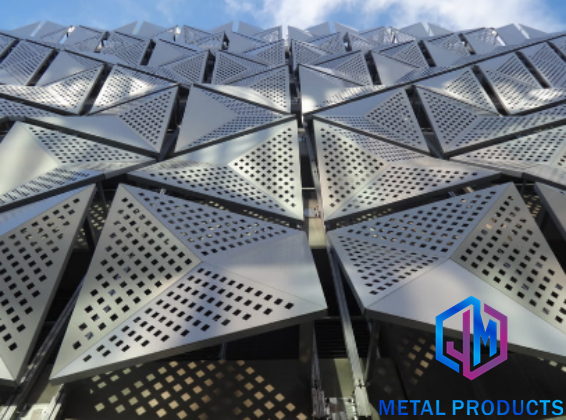
For this application, buyers should expect to discuss the Aluminium Perforated Facade Screen JM-P-416 (material thickness 1.5–3 mm, hole diameter 3–30 mm, open area 20–60%, PVDF or powder coating), the Expanded Metal Facade Cladding JM-E-573 (sheet thickness 2–4 mm, opening 20 mm × 48 mm, open area 35–55%, PVDF), the Facade Solar Screen Mesh JM-S-2602 (opening ratio 30–60%, PVDF) and the Parking Building Facade Mesh JM-S-2607 (opening 20 mm × 40 mm, open area 35–60%), all of which are documented through aluminium material data and coating schedules rather than stainless steel cloth standards.
Ceiling Systems
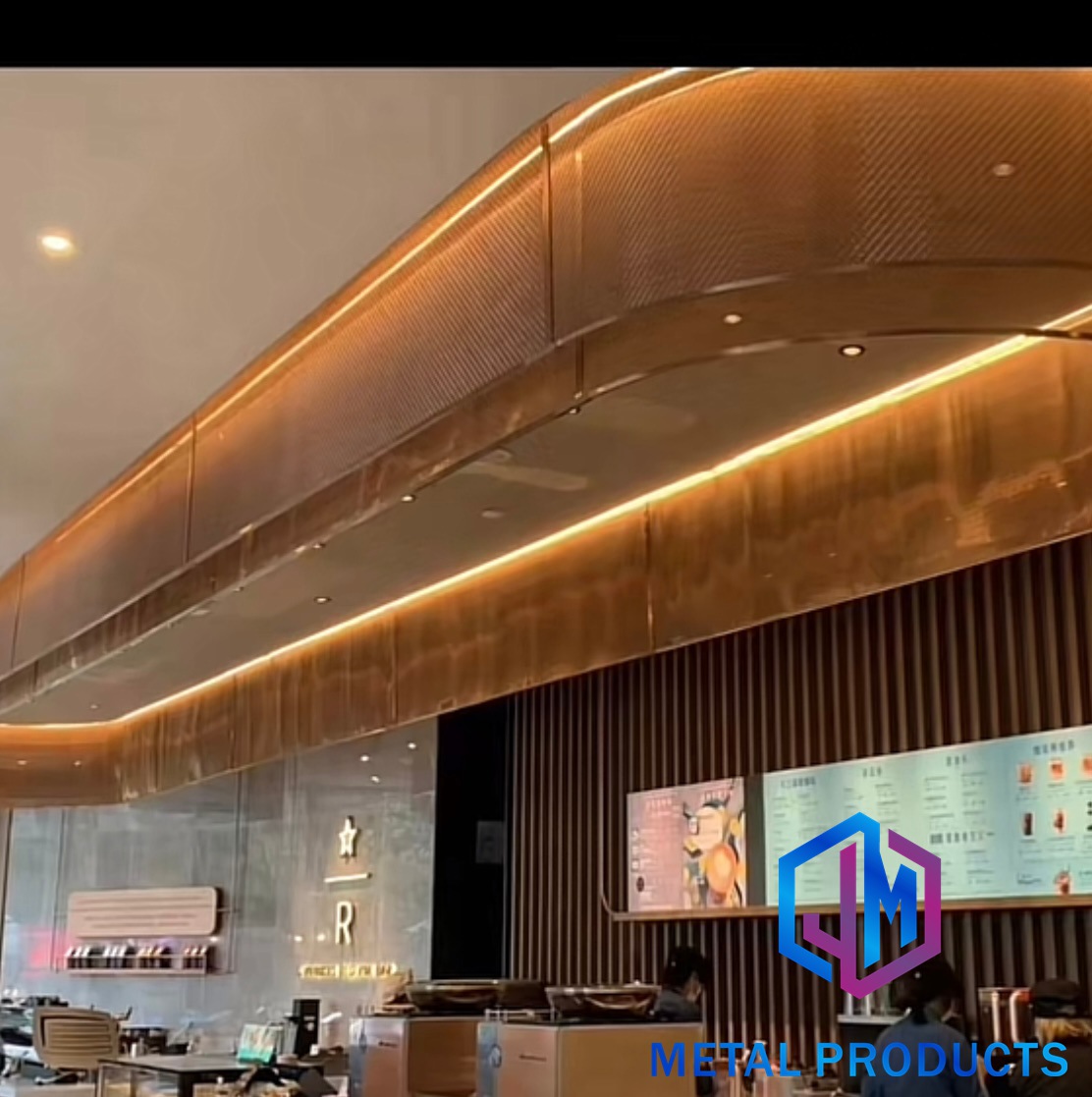
Ceiling mesh is an interior application in most cases, so the compliance emphasis moves from corrosion and wind to suspension, weight, finish consistency and fire-related project requirements. A custom ceiling mesh curtain installation covering 2,300 m² used a curved track system, flexible installation and an elegant draping effect with a lightweight structure; the stated outcome was a visual centrepiece with minimal maintenance requirements. Documented parameters for this category include the Aluminium Stretch Metal Ceiling Mesh JM-C-1013 (material thickness 1.5–3 mm, mesh opening 10 mm, open area 40%, suspended ceiling system), the Decorative Metal Ceiling Grid JM-NT-062 (customisable panel size and grid opening) and the Metal Ring Mesh Curtain JM-R-4205, mounted on a ceiling track system with custom colours available.
Balustrade and Safety Panels
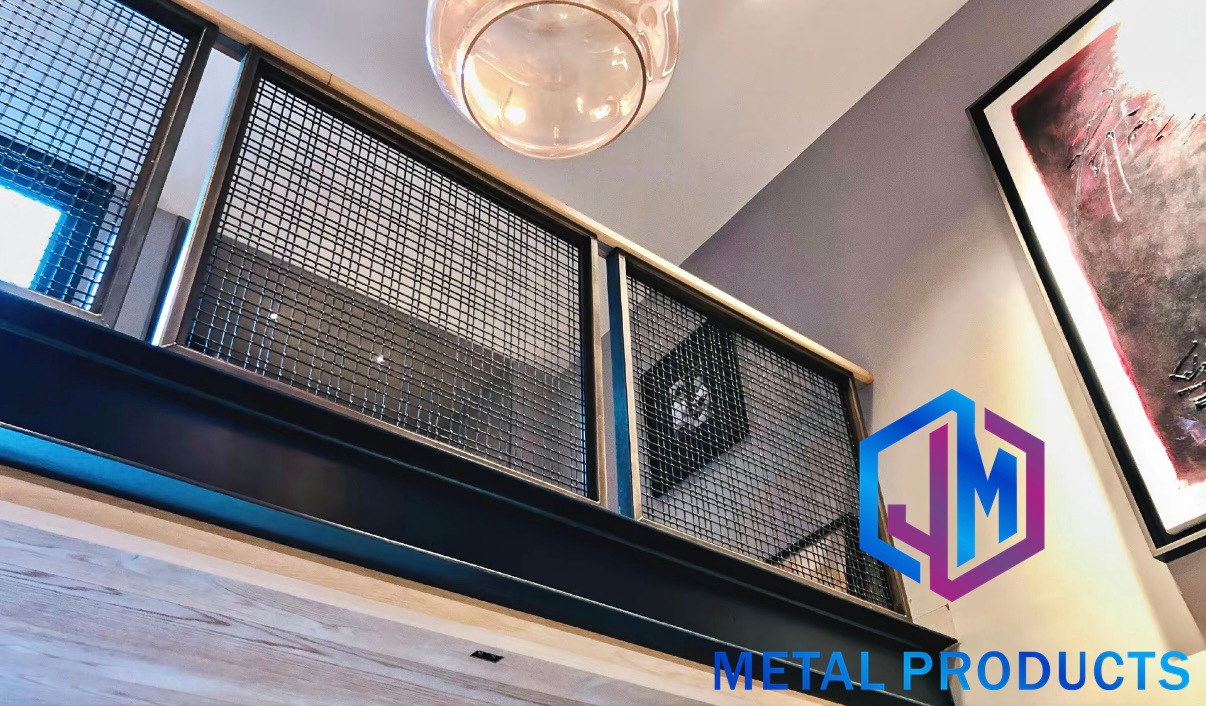
Balustrade and safety applications sit closest to the boundary between decorative mesh and safety components, so the aperture, wire or cable diameter and material grade are read as functional parameters. A 200 m² interior stair railing and corridor safety barrier project used custom mesh aperture sizes with a bronze finish, a rigid aluminium frame and a lightweight structure, balancing safety with decorative appearance and natural light penetration. Relevant documented options include the Metal Mesh Balustrade Panel JM-C-1017 (wire diameter 1–3 mm, customised mesh opening, frame installation available, indoor and outdoor use, stainless steel 304 or 316) and the Staircase Safety Metal Mesh JM-C-1082 (cable diameter 2–3 mm, mesh opening 40–100 mm, tensile structure available, stainless steel 316).
Decorative Partitions and Interior Screens
Interior partitions carry the lightest regional burden and the heaviest finish burden. A 40-unit reception area divider project for a sales office development used a delicate woven texture with a bronze finish, custom wire diameter and mesh density, an anti-tarnish brass surface treatment and a lightweight panel that was easy to cut and frame; the reported outcome was a hazy semi-transparent effect with stable structure after long-term use. A separate fit-out in the United Kingdom used custom diamond weave mesh with a brass antique finish for cabinet door inserts and display cabinet partitions. Documented options in this category include the Decorative Metal Mesh Partition JM-C-1013 (stainless steel 304, wire diameter 1–2 mm, mesh opening 5–10 mm, fixed frame), the Architectural Decorative Metal Mesh JM-C-1080 (stainless steel 304 or aluminium, wire 1.4 mm × 2.5 mm, antique copper finish, panel size according to project requirements) and the Titanium Coated Stainless Steel Mesh JM-C-1045 (stainless steel 316, titanium coating, black, bronze or gold).
Frequently Asked Questions
Which standards apply to architectural metal mesh, and do they differ by region?
There is no single standard. Stainless steel materials are commonly specified under EN 10088 in Europe; woven wire cloth for facades often references ASTM E2016; expanded metal mesh in architecture is governed by standards set by the NAAMM EMMA division; and Jumao’s EU-CPR Certificate of Conformity No. CTB160418002S-ZS lists EN 13830:2003 for its stated scope. Perforated and laser-cut panels are documented mainly through material grade, thickness, hole pattern, open area and coating. Regionally, EU projects centre on CE-CPR and material standards, North American projects commonly reference ASTM and NAAMM frameworks, and other markets are usually governed by the local authority together with the project specification.
What documents can a supplier reasonably be asked to provide for each application?
For any application, the reasonable core set is: material grade confirmation, a parameter sheet covering thickness, aperture or hole diameter, open area, panel size, frame or fixing method and surface finish, and the applicable conformity certificate where one exists for that product. Jumao additionally provides engineering drawing support, installation system recommendations, installation guidance and maintenance advice, and offers third-party inspection such as SGS and TUV. Production records cover raw material inspection, dimensional inspection, welding quality inspection, surface finish inspection, flatness inspection, colour consistency inspection, packaging inspection and 100% pre-shipment quality inspection.
What are the commercial constraints — MOQ, lead time and customisation limits?
Jumao’s minimum order quantity is 1 square metre, lead time is 7–60 days depending on order quantity and customisation requirements, and monthly capacity is 5,000–10,000 square metres. Customisation covers mesh pattern, opening size, wire diameter, material grade such as stainless steel 304 or 316, aluminium, brass or copper, panel dimensions, frame structure, edge treatment, surface finish including PVDF coating, powder coating, anodising, PVD and antique finish, RAL custom colours, branding or logo marking and packaging. Because documentation and sampling run alongside production planning, buyers should confirm both the commercial terms and the document pack before releasing a project schedule.
How should a buyer validate a mesh specification before full production?
Validate on two tracks at the same time. On the physical track, request a sample in the specified material grade, aperture and finish, then check colour consistency, flatness and the panel size and edge treatment that your frame design requires. On the document track, compare the parameter sheet against the drawing, and check that any certificate named covers the actual model. The 1 square metre minimum order quantity makes a small validation order practical, and the sample should match the documents, not replace them.
How do you verify CE-compliant architectural metal mesh manufacturers for facade projects?
Start with the certificate, not with the claim. Jumao’s Certificate of Conformity (EU-CPR), number CTB160418002S-ZS, was issued by Shenzhen CTB Testing Technology Co., Ltd for the EU market, with EN 13830:2003 listed as the standard, a scope naming Metal Mesh Curtain, Model JM-MMC, Trade Name JUMAO, an issue date of 2016-04-25 and an expiry date of 2099-12-31. The products associated with this certificate include Architectural Decorative Metal Mesh (JM-C-1080), Ceiling Hanging Mesh Curtain (JM-R-4205) and Hotel Decoration Metal Mesh (JM-A-822). Because the scope names specific products, the verification step is to confirm that the model you intend to order appears in the scope, then request the complete project document set — material data, parameter sheet, coating schedule and third-party inspection if required. To check whether a specific panel matches your project’s documentation requirements, send the drawing, aperture and material grade to info@jumao-decorfabric.com, or review the range at www.jumao-decorfabric.com.
Conclusion: Compliance Is a Structure, Not a Sentence
Architectural metal mesh compliance works as a four-layer structure: material standard, construction-specific reference, certificate scope, and project-level requirement. Once those layers are separated, the questions become answerable. A woven 316 facade mesh and an aluminium expanded ceiling panel are not documented in the same way, and a single certificate will rarely cover both. Buyers who ask for the model, the market and the validity date before accepting a document — and who state their aperture, open area, material grade and coating in writing — avoid most submittal rejections before production starts.
Shenzhou City Jumao Metal Products Co., Ltd (Jumao) is a manufacturer and exporter of custom architectural metal decorative materials, founded in 2016 and operating a 3,000 m² facility in Anping, Hengshui, Hebei, China, with 50 employees, 6 R&D engineers and an annual output of 100,000 m², exporting around 50% of production to the Middle East, Southeast Asia, the European Union, North America, Australia and Africa. The company offers full OEM and ODM customisation on material, size, weave pattern, PVDF coating and design drawings, with a 1 m² minimum order quantity.
Build the document pack before you build the facade
Send your application type, material grade, aperture or hole pattern and target market, and Jumao will return the matching parameter sheet, available conformity documentation and a sample at the specified specification. Request a sample and quotation, or ask which certificate applies to your model.
Email: info@jumao-decorfabric.com | Tel / WhatsApp: +86-151-2783-7706 | www.jumao-decorfabric.com
Contact: ViVi Su | Address: 2km South Of Bus Station, Anping, Hengshui, Hebei, China 053600
Have Questions or Need More Details?
Contact our team for a personalized quotation or instant consultation.
Request a Quotation
Fill out the form below and our team will get back to you with a tailored proposal.
WhatsApp Direct Chat
Prefer to chat in real-time? Message us on WhatsApp for instant assistance & quick answers.
- Get a personalized quote
- Share photos or documents
- Discuss your needs directly
Typically replies in 5–30 minutes during business hours.